Effective inheritance tax rates: Why large inheritances go almost untaxed
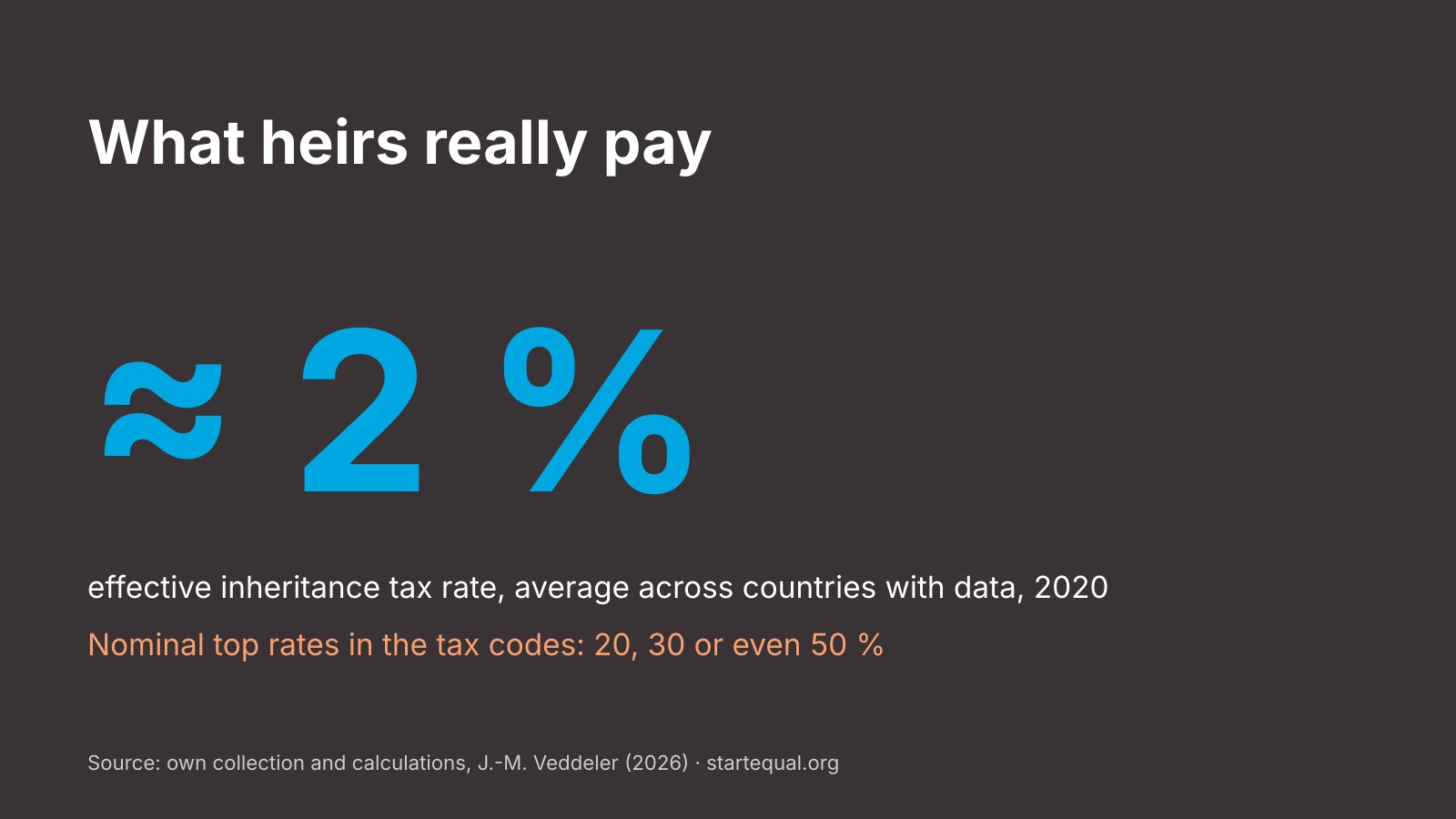
Inherited wealth is on the rise. Depending on the estimate, around half of private wealth in rich countries is inherited rather than self-made, and the share has been climbing steeply since the 1970s. Given this growing relevance, one would expect inheritance taxation to counteract the negative effects on equality of opportunity through increased, progressive and effective taxation. The opposite is the case: top inheritance tax rates have been cut in many countries since the 1970s, the revenue is negligible, and some countries have abolished the tax altogether. And the situation is even worse than official tax statistics and popular opinion suggest, because both look at nominal rates and at reported inheritances only. If we measure what heirs actually pay against what is actually passed on, the effective inheritance tax rate is as low as 1–2% in some countries and below 5% in most. Inheritance taxation is as toothless as a paper tiger. We need to remind ourselves what this means: around 95% of wealth is passed on untaxed to the next generation.
The data behind this article
120 years of inheritance tax data for ten countries – effective rates, tax revenue, inheritance flows and the share of inherited wealth, with every source and method note. Free to explore and download.
Nominal rates: impressive on paper
Looking at the tax codes of many countries, you find top inheritance tax rates of 20, 30 or even 50%.[1] This suggests quite a substantial intervention into the flow of unearned privilege from one generation to the next. Over the past 50 years, there is no clear common trend in these top rates: some countries, such as France and Germany, have increased them, while others, such as the United States, the UK and Japan, have cut them substantially.
But nominal rates obscure the real situation. A top rate only applies to the part of an estate above the highest threshold, and only to what is left after exemptions, reliefs and valuation discounts – and only to what is declared at all. What matters for equality of opportunity is not the rate printed in the law, but the share of inherited wealth that actually ends up as tax revenue.
Revenue: less than the alcohol tax
A first hint comes from public revenue. Across the whole OECD, only 0.36% of total tax revenue comes from inheritance, estate and gift taxes. As some countries have abolished the tax altogether, the share is slightly higher for those countries that still levy it: 0.51%.[2] This is less than many countries raise from special taxes such as the alcohol tax, which underlines the insignificance of current inheritance tax regimes. It stands in stark contrast to the hundreds of billions of euros that are inherited every year in many countries.
Measuring what is really inherited
Unfortunately, there is no easy and good source of data for effective inheritance tax rates, because they rely on estimates of the total volume of inheritances and gifts – and this volume is exactly what nobody observes directly:
- Tax statistics only show taxed inheritances. Many “normal” inheritances, like the family home or a small business, are not taxed because of high personal allowances and never show up. Neither do unreported transfers.
- Household surveys such as the German SOEP or the European HFCS underreport inheritances: the very wealthy rarely participate, people underreport what they received, and transfers within the household are often not recorded.
- Macroeconomic estimates combine private wealth, mortality tables and the observed age–wealth profile to estimate the “economic” inheritance flow. Their accuracy depends on the quality of the underlying wealth data.
Following the distinction made by Thomas Piketty and other researchers, we have collected data from various studies and tax statistics and separated two kinds of indicators.[3] The effective inheritance tax rate puts the revenue from inheritance and gift taxes in relation to the best available estimate of the true, economic inheritance flow. The average rate puts it in relation to the largely unadjusted inheritance volume from the tax statistics. Given the problems with data quality and the varying methods of the sources, the numbers are not 100% accurate, but they suffice to capture the broad trends and orders of magnitude.
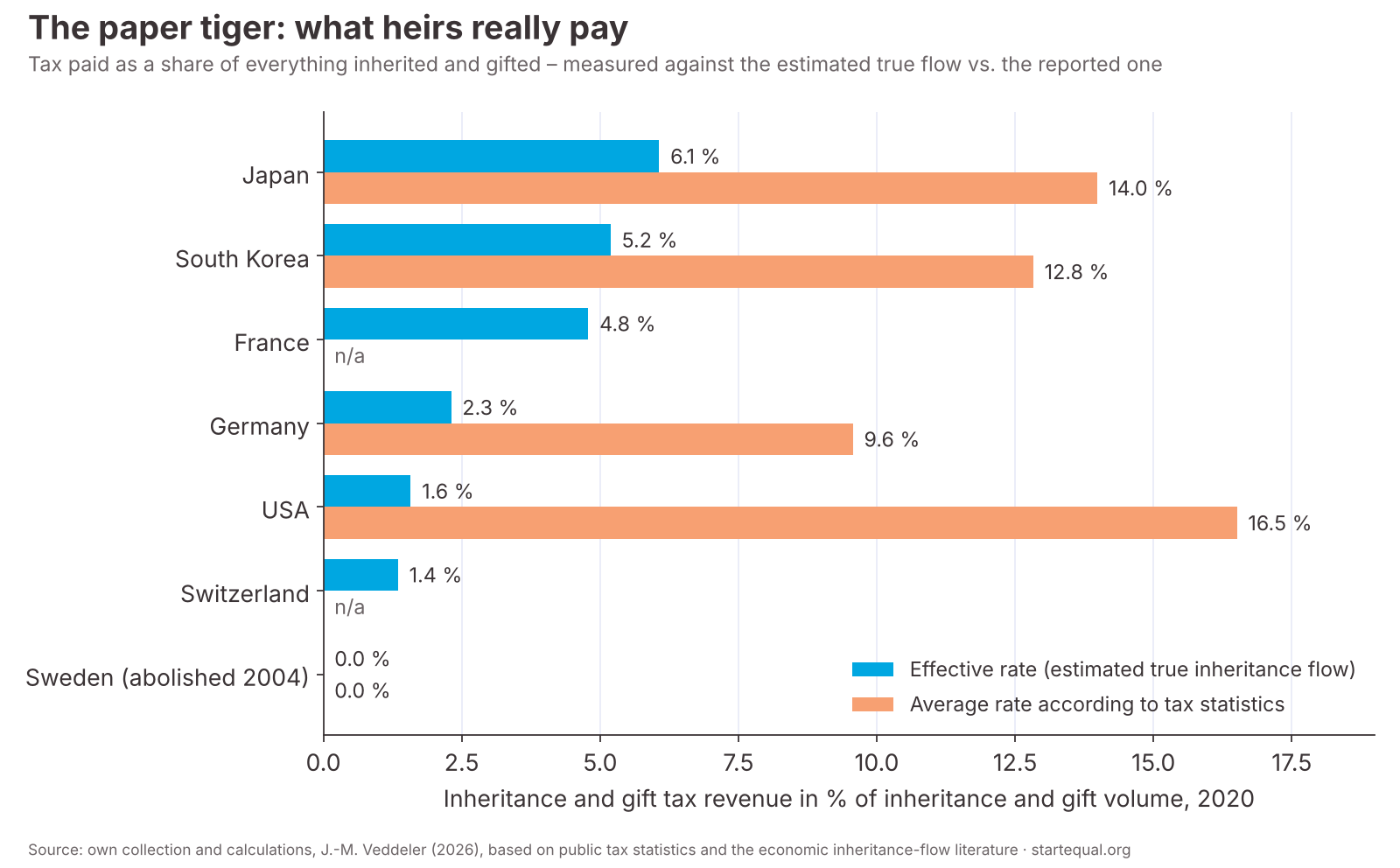
The gap between the two measures is large. In Germany, the tax statistics suggest that heirs and recipients of gifts pay on average almost 10% of what they receive. Measured against the estimated true inheritance flow, it is 2.3%. In the United States, the tax statistics even suggest an average rate of more than 16% – but they only include the estates that are actually taxable, around 0.2% of all estates. In Germany, about 10% of estates pay inheritance tax. Measured against everything Americans inherit, the federal estate tax takes about 1.6%. As a rule of thumb, rates based on tax statistics are typically two to four times above the likely real value. Japan and South Korea stand out as the “best among the bad”, with effective rates above 5%. Sweden abolished its inheritance and gift tax in 2004, and its effective rate is zero.
A falling trend since 2000
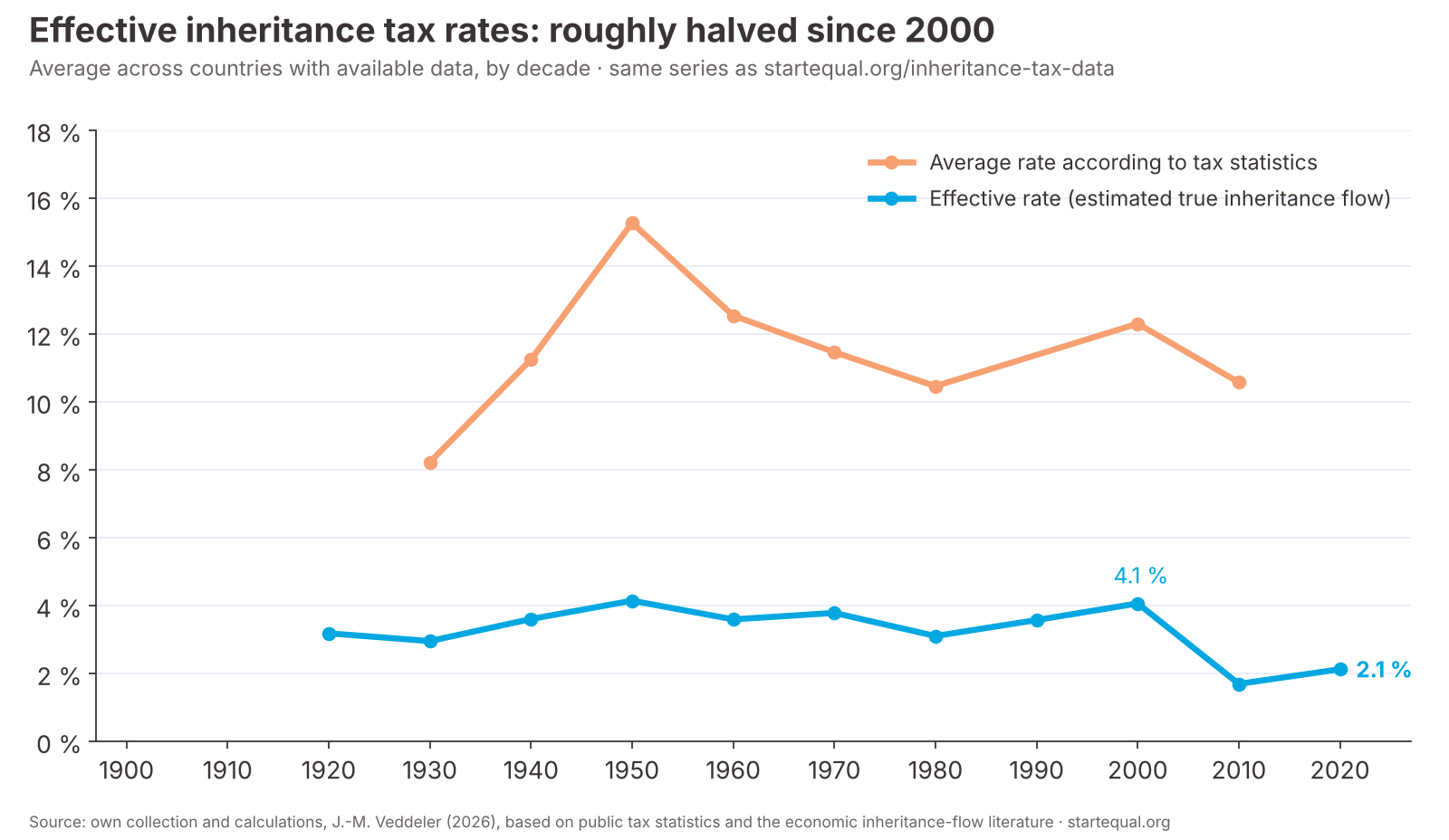
Over the long run, effective inheritance tax rates have always been marginal, in a range of 1–5%. On average, they stayed at around 3–4% for most of the 20th century and have roughly halved since 2000. After the financial crisis, there has been a gentle reversal of the negative trend, but overall rates remain at marginal levels – far below what is implied by nominal tax rates, by public perception, by what people believe according to surveys, and by official inheritance tax statistics. Researchers using a different method arrive at the same picture: the average tax rate on inheritances is not keeping up with the rise of inheritance flows.[4]
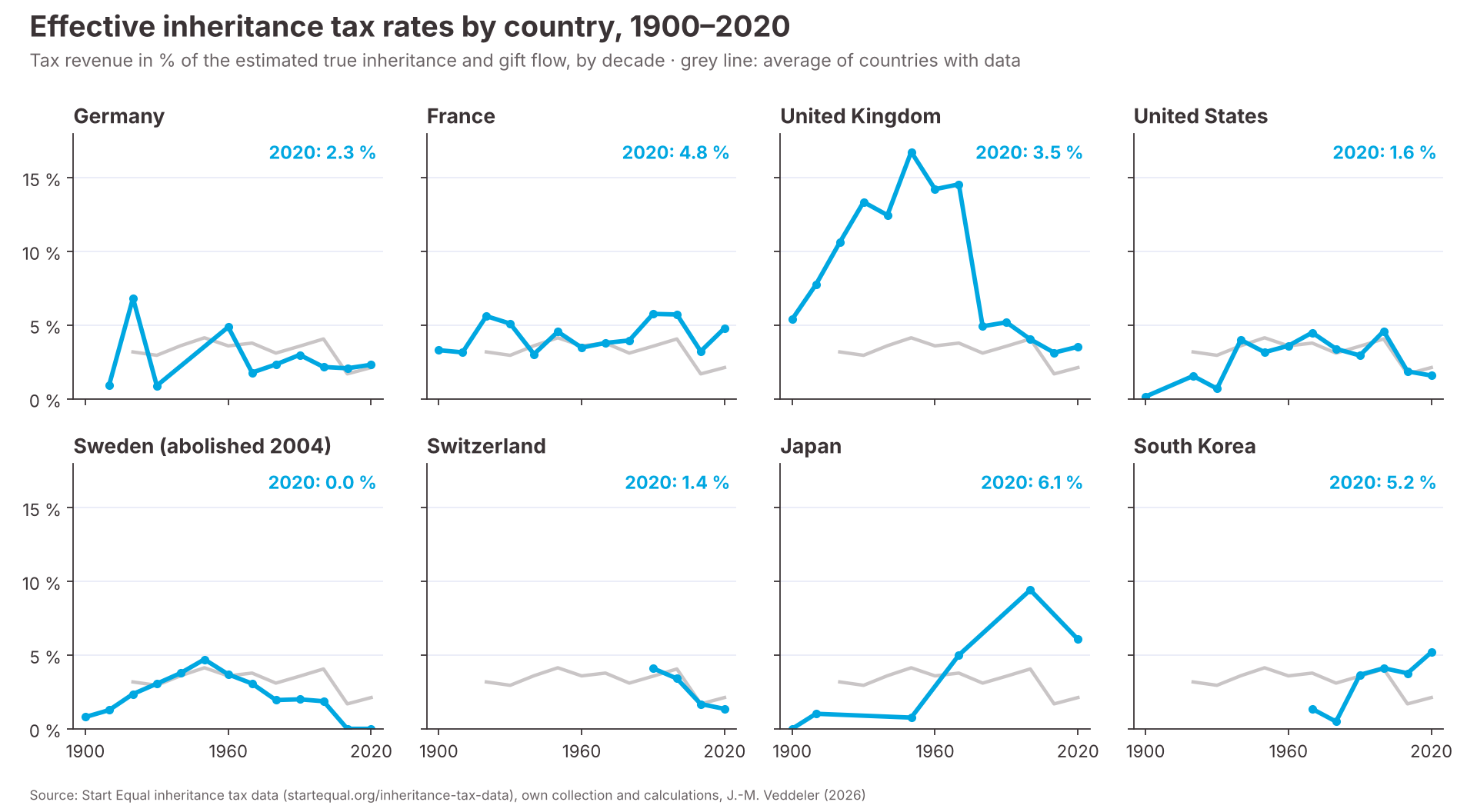
Behind the average, countries followed quite different paths:
If we compare this long-run trend with the development of wealth inequality, as proxied by the wealth share of the top 1%, we can see some link between the two.[5] Inequality reached its historic low around 1980, while effective inheritance tax rates were still at around 3–4%. Since then, inequality has been rising, and since 2000 effective inheritance tax rates have roughly halved. Since the financial crisis of 2008, inheritance tax rates are mildly increasing again, while inequality has stabilised at high levels. This is no proof of causality, but it is hard to ignore.
Regressive at the very top
Effective inheritance taxation is not only shockingly weak overall. In some countries, it is also regressive: heirs of the rich pay less inheritance tax, as a share of what they receive, than heirs from less wealthy backgrounds. Modern tax systems are usually designed to be progressive, as the stronger backs should shoulder the larger burden. Tax avoidance and evasion options at the very top of the wealth distribution, however, have led to the opposite result.
In Germany, due to very generous exemptions for business assets, the average inheritance tax rate for bequests of more than €20 million was 4.8% in 2023, compared to 8% across all taxed cases.[6] Among those who applied for the special exemptions, the average tax rate was close to zero. In the UK, the picture is mixed. After a generally progressive curve, the average inheritance tax rate drops from around 25% for estates between £4 and 5 million to around 12% for the largest estates, compared to an overall average of 13%.[7] The regressivity is mild and only present at the very top – but any ordinary citizen and common sense of justice would expect the strongest of the strongest to shoulder the largest contribution, not the opposite. In the US, the estate tax is “progressive” only in the sense that it has very high exemption thresholds of more than ten million dollars per person, while the effective rate stays at around 1% even for the richest of the rich.
All of these figures are based on official tax statistics, which notoriously underreport real inheritance and gift flows. It is safe to assume that this is particularly true at the top of the wealth distribution, where wealth is easiest to hide offshore or to restructure. Real inheritance taxation is therefore likely to be even more regressive than the statistics reveal.
How the tiger lost its teeth
The shockingly low, decreasing and partly regressive effective inheritance tax rates are the product of three developments:
- decreasing nominal tax rates, including the abolition of inheritance and gift taxes altogether in some countries;
- increasing thresholds and exemptions, allowing for more legal tax avoidance;
- continuing illegal tax evasion.
Germany is a case in point for increasing tax avoidance. Effective tax rates on gifts are much lower than on bequests. Gifts can be planned carefully, exploiting every possible exemption and loophole, whereas inheritance tax may also fall due after a sudden death, when no optimal planning was possible. The exemptions for business property play a key role here, and they have repeatedly been challenged by the Federal Constitutional Court. We have discussed elsewhere why family businesses do not need these privileges and why tax avoidance is no killer argument against inheritance taxation – it is an argument for closing the loopholes, and for treating gifts and inheritances alike.
What is at stake
How much could an inheritance tax raise if it actually had teeth? As a simple back-of-the-envelope calculation, let us assume a 100% inheritance tax. If around half of wealth is inherited, future inheritance volumes would sooner or later fall to about half of today’s level, as only the self-earned part would remain and the rest would be taxed away in every generation. For Germany, this would mean that of the roughly €350 billion currently estimated to be passed on each year, about €175 billion could be regarded as the longer-term inheritance tax revenue – at a 100% rate, without avoidance and without evasion. That is 13.4% of total tax revenue: close to the contribution of VAT (17.2%), nearly twice as much as corporate and property taxes together (7.6%), and around half of the personal income tax (27%).
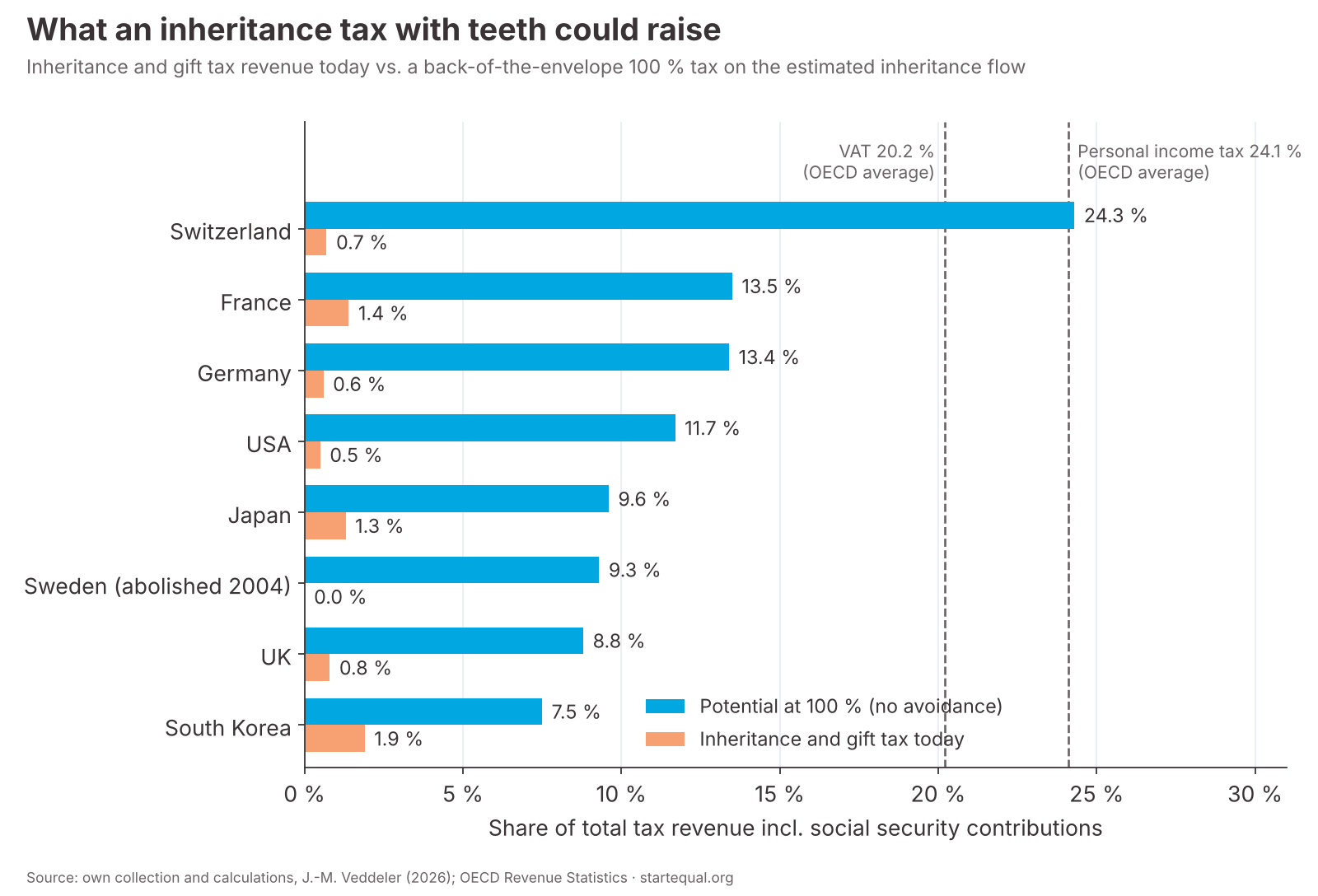
Share of total tax revenue incl. social security contributions. Potential based on the estimated inheritance flow and the share of inherited wealth in each country (South Korea: tax statistics and an assumed 50% share). Source: own calculations, J.-M. Veddeler (2026).
This is only an indication. The estimates of inheritance volumes are subject to error, and a 100% tax would trigger avoidance, more charitable giving and perhaps reduced motives to accumulate wealth. The flows also include transfers within a generation, from wife to husband or brother to sister, which do not recur in every generation. On the other hand, much greater equality of opportunity would let more talents thrive, and a universal basic inheritance financed from the revenue would partly be saved and invested, building new taxable wealth. The point is not the exact number. The point is the order of magnitude: between what inheritance taxation raises today and what it could raise, there is a factor of ten to twenty.
Even for those who believe a 100% inheritance tax could never be implemented, the comparison with the income tax is instructive. Had someone written a paper in 1900 on the revenue potential of a 100% income tax, people would have declared them mad. A hundred years later, top marginal income tax rates are beyond 50% in many countries, and the average burden on income including social security is around 25 to 30%. If we reached such levels with inheritance taxation, we would already live in a different world.
Conclusion: give the tiger its teeth back
The debate on inheritance tax is usually conducted with nominal rates of 30, 40 or 50% – and with the fear that the tax “takes away” family wealth. The data tell a different story. Measured against what is really passed on, heirs pay between 1 and 5%, with a falling tendency since the 1970s, and the largest fortunes often pay least. Inheritance is the least taxed form of income, although it is the one that is least earned. Before we argue about higher rates, we should make the existing ones real: fewer exemptions, equal treatment of gifts and bequests, of business and private wealth – and a revenue that is visibly returned to the next generation as a universal basic inheritance. As Thomas Paine proposed in 1797, the wealth of one generation should give every member of the next a fair start.
Sources and further reading
[1] Long-run top inheritance tax rates (direct line): Piketty, T. (2014). Capital in the Twenty-First Century. Harvard University Press.
[2] OECD (2021). Inheritance Taxation in OECD Countries. OECD Tax Policy Studies, No. 28. OECD Publishing, Paris. https://doi.org/10.1787/e2879a7d-en
[3] Own collection and calculations, Veddeler, J.-M. (2026), based on public inheritance tax statistics and the economic inheritance-flow literature, e.g. Piketty, T. (2011). On the Long-Run Evolution of Inheritance: France 1820–2050. Quarterly Journal of Economics 126(3): 1071–1131. The global averages are simple averages across the countries with data in each decade.
[4] Guzzardi, D. and Morelli, S. (2025). The Return of Inheritance. Conference presentation, 2nd III/LIS Comparative Economic Inequality Conference, Luxembourg, 26 February 2025.
[5] World Inequality Database, top 1% wealth share. wid.world
[6] Official German inheritance and gift tax statistics (Statistisches Bundesamt), 2023.
[7] Goss (2024). The Future of Inheritance Tax: Options to Repair Inheritance Tax in Britain. Demos. PDF Full data with all sources: startequal.org/inheritance-tax-data.
Featured image and charts: own data and calculations, J.-M. Veddeler (2026).