Basic Inheritance Light: What real-world baby bonds teach us about a universal basic inheritance

When the public debate talks about a basic inheritance, it usually discusses it as a redistributive reform of inheritance taxation: tax large inheritances more and give every young adult a starting capital in return. What is often overlooked is that since the 2000s, numerous “basic inheritance light” schemes have quietly been implemented around the world. Known as Child Development Accounts (CDAs) or asset-based policies, following Michael Sherraden’s influential work[1], these programmes mainly aim at fighting individual poverty through saving incentives and educational support, rather than at a substantial correction of wealth concentration. Still, they serve as real-world pilots: they prove that universal starting capital is administratively and politically feasible.
This article looks at the most important of these schemes, compares how much they actually give to young people, and asks what we can learn from them for a real universal basic inheritance.
Same, but different: maternity grants and child allowances
Nearly all countries in the world have some kind of financial support scheme around children. These are usually either monthly child allowances or one-off maternity or baby-bonus cash grants, such as Finland’s Maternity Grant issued since 1937, Russia’s Maternity (Family) Capital with significant amounts of a couple of thousand euros, the UK’s Sure Start Maternity Grant or Ireland’s New Baby Grant. Both don’t quite fall into the category of a universal capital endowment, as they are paid to the parents’ generation as an incentive or support in raising children.
In contrast, Child Development Accounts clearly target wealth accumulation in the young generation itself, in the spirit of a universal basic capital. The money is put aside for the child, and typically locked until the age of maturity.
How to compare apples with oranges
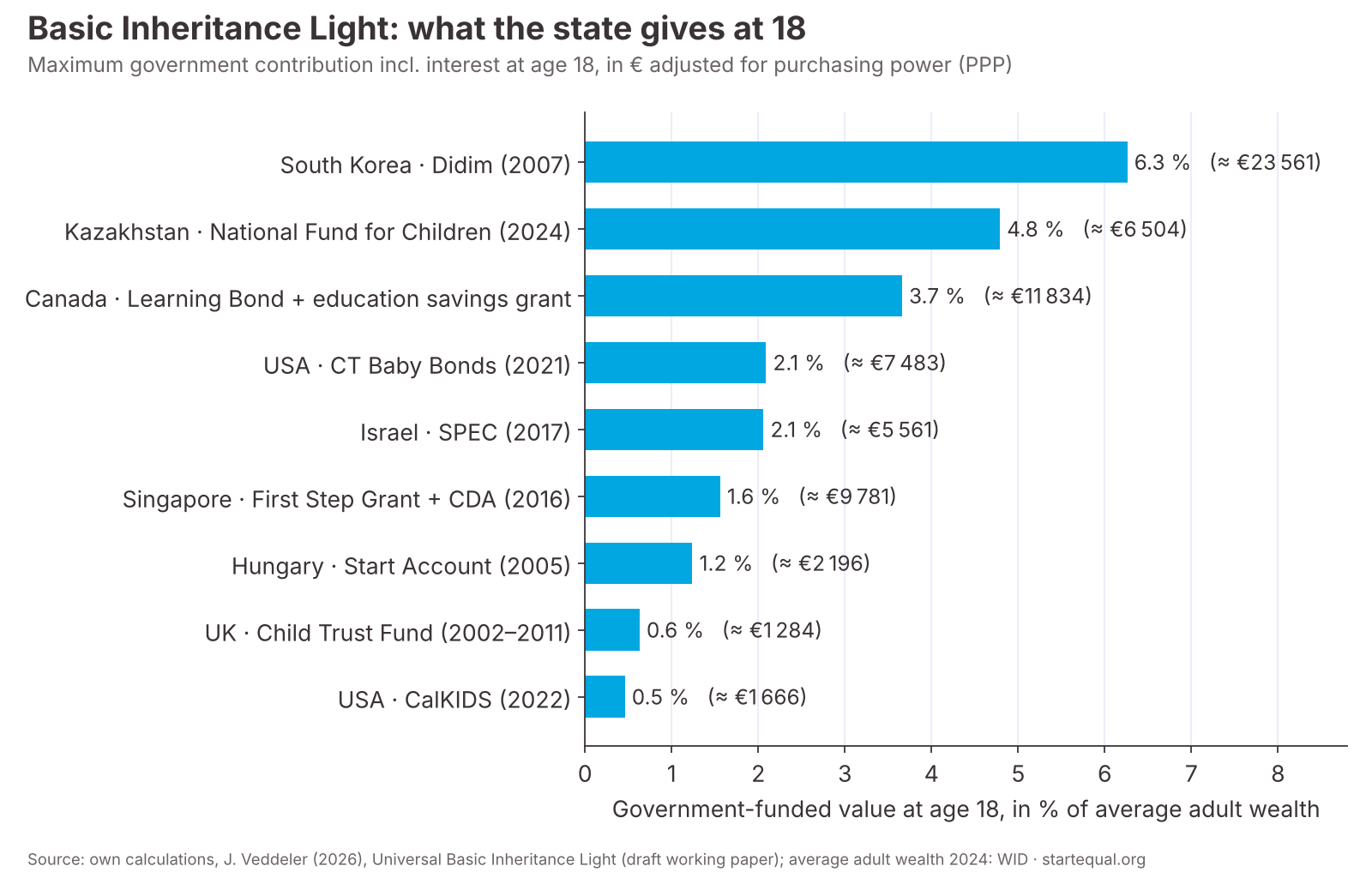
To compare the programmes with each other, I made an imperfect attempt to harmonise the government-funded value of the capital grants at the age of maturity (18 years). This assumes that families put in the private savings needed to get the maximum government match funding, that nothing is spent before the age of 18 even where a scheme allows it, and it applies the interest rate explicitly granted for the specific financial product. Where this doesn’t exist, rates used in sample calculations by the respective government or typical rates for low to medium risk investments in the respective country are used. The interest rates thus vary between 2% and 7%. The resulting value is given in euros, adjusted for purchasing power (PPP), and put into relation to the average wealth of an adult in 2024 in the respective country.[2] This way, an imperfect but still meaningful comparison of the dimensions of the different schemes can be made.
A tour around the world
United Kingdom – the Child Trust Fund (2002–2011). The UK’s Child Trust Fund (CTF), announced in Labour’s 2001 election manifesto, aimed to give every child born from September 2002 a financial head start. It goes back to the “baby bond” idea developed by Gavin Kelly and Rachel Lissauer at the think tank IPPR.[3] Each child received a government voucher (£250, or £500 for lower-income families) to open a tax-free savings account, with a second payment at age seven. Families could add to the account, which couldn’t be accessed until the child turned 18. Without any private saving, the two government payments – even in their higher form and with 3% interest – yield only around €1,300 (PPP) at 18, about 0.5% of the average wealth of UK adults. The CTF was well-received and widely adopted: by 2010, more than £3 billion had been saved in these accounts. Despite this, it was scrapped in 2011 by the new Conservative–Liberal Democrat coalition. More on that below.
Hungary – the Start Account (2005). Hungary created a system of allowances for children that invests exclusively in a dedicated Baby Bond government security. It combines a seed deposit at birth of about €110 (HUF 42,500) with a state subsidy of 10% on annual private deposits, capped at around €30 per year. The baby bond guarantees an inflation-linked yield (CPI plus 3%). If families manage to save the roughly €25 a month needed for the maximum support, the young adult will have around €17,500 (PPP) at 18 – but the government-funded part is only around €2,200 (PPP), or a bit more than 1% of average adult wealth. By 2025, 400,000 such accounts had been opened.
Canada – the Learning Bond (2004). The Canada Learning Bond helps low-income families save for their child’s post-secondary education, without requiring personal contributions: an initial C$500 plus C$100 for each further year, up to C$2,000, paid into the child’s education savings plan. On top, the Canada Education Savings Grant matches family savings by up to 20%. In total, the maximum government contribution at maturity is worth about €12,000 (PPP), close to 4% of average adult wealth. However, if the beneficiary does not pursue post-secondary education, the money goes back to the government. The scheme therefore primarily benefits middle and upper-class children who actually go to university, and leaves no freedom to use the money for housing, starting a business or anything else.
South Korea – Didim Seed Savings Accounts (2007). South Korea’s Didim accounts are a targeted, opt-in scheme for vulnerable and low-income children, by now covering about half of the child population. At its core, it is a matched saving scheme with a generous 1:2 government match. Crucially, children without any family or sponsor contributions receive unmatched government support, which makes it more than a pure saving incentive. At its maximum, the government-funded part can approach €24,000 (PPP) at the age of maturity – around 6% of average adult wealth, the highest share in this comparison. Funds can be withdrawn from 18 for dedicated purposes, and from 24 they are free to use. In 2024, young adults spent their withdrawals on tuition (37%), housing (19%), technical qualification (17%), medical expenses (5%), and smaller shares on business start-ups and marriage. These are insightful figures: they show the importance of a liberal approach to how the money can be used, and are a warning against all-too-narrow, higher-education-only schemes.
Singapore – First Step Grant and CDA (2016). Singapore has had Child Development Accounts since 2001, in which the state matches parents’ savings one-to-one up to a cap. In 2016 it added a more direct capital endowment, the First Step Grant, now S$5,000 for the first and second child and S$10,000 from the third child onwards. In contrast to other schemes, the money can be accessed at any time, but only for child development purposes such as childcare or healthcare. At 13, the balance moves into a post-secondary education account, and at 30 any unused balance rolls into the Central Provident Fund, Singapore’s central pension and asset-building scheme. An ambitious, integrated life-long approach – but as parents can draw on the funds throughout childhood, it is uncertain whether a substantial basic inheritance survives until adulthood. If untouched, the government contribution would be worth around €10,000 (PPP) at 18, about 1.5% of average adult wealth in wealthy Singapore.
Israel – Savings Plan for Every Child (2017). Israel’s SPEC is the world’s first near-universal CDA with monthly government deposits: the National Insurance Institute pays NIS 57 per month into an account for every child under 18, including Palestinian children in East Jerusalem with permanent residency. Parents can double this by channelling their child allowance into the account. Small bonus grants are paid at culturally important milestones – at age 3, at bar/bat mitzvah age, and at 21 if nothing has been withdrawn until then. By 2025, 4.6 million children were enrolled. From a basic inheritance perspective, SPEC is particularly interesting as it is universal, unconditional and not tied to any private savings. With a low to medium risk investment, it results in a basic inheritance of around €5,000 (PPP), roughly 2% of average adult wealth – or double that if parents also save the child allowance.
USA – CT Baby Bonds (2021), CalKIDS (2022) and “Trump accounts” (2025). Connecticut was the first US state to introduce a significant capital endowment. It is not universal but targets low-income households: for every child born under Medicaid coverage since July 2023, the state invests $3,200, which may grow to about €7,500 (PPP) at 18, around 2% of average US adult wealth. The money can be used for buying a home or starting a business in Connecticut, for education, or for retirement savings. California’s CalKIDS is narrower and only for higher education; for a child from a low-income family, its value at 18 is around €1,600 (PPP), or 0.5% of average adult wealth. Most recently, the One Big Beautiful Bill Act introduced the “Trump accounts”: a $1,000 payment at birth, invested in stock funds and locked until 18, when it converts into a retirement account. Without any private contributions, the government itself estimates a balance of only about $5,800 at 18.[4] At the same time, the same act cuts support for the least well-off, which may well render the overall effect on unequal starting positions weak or even negative.
Kazakhstan – National Fund for Children (2024). Kazakhstan’s scheme uses a unique funding model: half of the annual earnings of the country’s fossil-fuel-driven sovereign wealth fund are channelled directly into accounts for around 7 million children, held in US dollars and locked until 18, then usable for housing and education. The first cohort of more than 300,000 young adults received only around $100 each in 2024, as the fund has just started, but the targeted amount at maturity is around €6,500 (PPP) – almost 5% of average adult wealth.
Lesson 1: Only “light” – real utopias vs. political reality
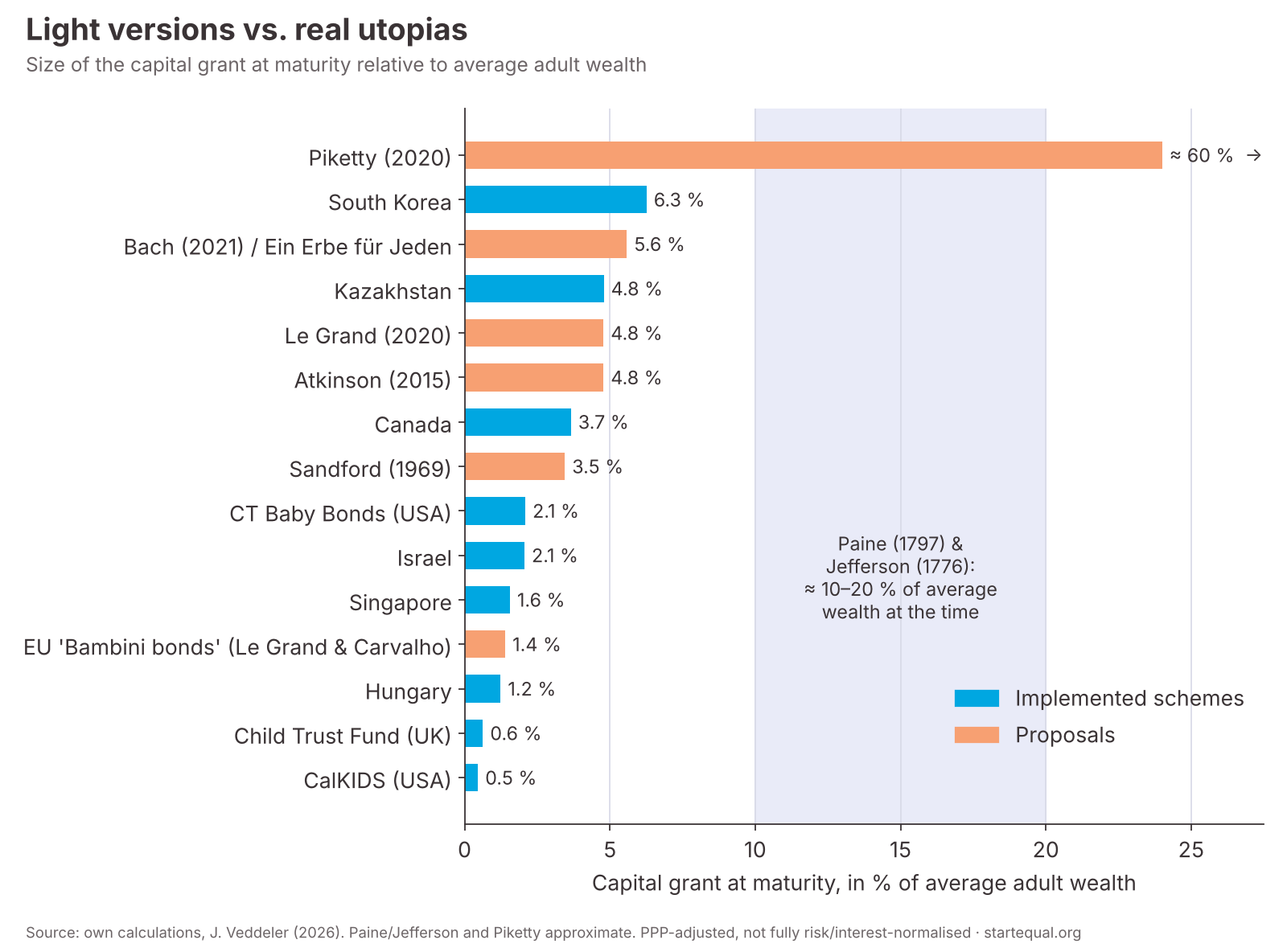
A systematic comparison reveals a gap between theoretical proposals and real-world schemes. Thomas Paine (1797) demanded about half a worker’s annual income for every young adult, and Thomas Jefferson’s (1776) land grant was worth about eight months’ wages – both around 10–20% of average wealth at the time.[5] Alexander Rüstow’s (1949) ordo-liberal “starting justice” would amount to several hundred thousand euros today, and Thomas Piketty (2020) proposed around €120,000, roughly 60% of average wealth.[6] More modestly, Stefan Bach (2021) suggested €20,000 for Germany, around 5–6% of average adult wealth.[7]
Real schemes fall far behind: Israel’s SPEC reaches about 2%, Hungary 1%, and the British CTF only 0.5%. The new Trump accounts are in the same league. Higher shares are only reached by schemes that are earmarked (Canada, ~4%) or means-tested (South Korea, ~6%). A special case between theory and practice is the German foundation Ein Erbe für Jeden, which raffles a €20,000 basic inheritance as a pilot project.
Lesson 2: Limited universality and paternalistic strings
The liberal ideal of a basic inheritance is an unconditional “springboard” (Le Grand) and a “minimum inheritance for all” (Atkinson).[8] Modern variants, in contrast, often come with strong paternalistic earmarking, sometimes with means-testing, and thus limited universality. In Canada, the payout is strictly tied to tertiary education, with a potentially regressive effect. Singapore limits use to health and education until unused funds flow into the pension fund at 30. South Korea’s experience shows that once young people are free to choose, they invest in a broad range of things that matter for their lives – from housing to vocational qualifications.
| Universal? | Conditions on use | Locked until maturity | Grant or match funding | |
|---|---|---|---|---|
| Canada | Progressive | Tertiary education | Yes | Grant + match |
| Hungary | Yes | None | Yes | Grant + match |
| Israel | Yes | None | Yes | Grant |
| Kazakhstan | Yes | Housing, education | Yes | Grant |
| South Korea | Low/medium-income households | Low; none after 24 | Yes | Match (grant if unmatched) |
| Singapore | Yes, higher for 3rd+ child | Low | No, usable for child development | Grant + match |
| USA – CalKIDS | Progressive | Higher education | Yes | Grant |
| USA – CT Baby Bonds | Low-income households | Low/medium | Yes | Grant |
| UK – Child Trust Fund | Progressive | None | Yes | Grant |
Lesson 3: Decoupled from inheritance
Classic proposals (Paine, Skidmore, Huet) as well as modern ones (Atkinson, Piketty) link the basic inheritance directly to inheritance taxation – to neutralise the “accident of birth” fiscally. Others, such as Sandford and Le Grand, rely on wealth taxes. In practice, this link has largely been lost. The British CTF was financed from general taxation. Newer approaches, such as Kazakhstan’s, use returns from fossil resource funds. This reinterprets the basic inheritance as a share in our common natural inheritance – very much in Paine’s spirit – but it decouples it from the redistribution of private wealth concentration.
Lesson 4: The political economy of visibility
Why was a popular scheme like the Child Trust Fund abolished so easily? “Light” models lack political resilience. Without immediate beneficiaries, the CTF had no lobby, and the distant benefit remained too abstract for parents. The people most affected – future beneficiaries – could not protest. As Gavin Kelly, one of its intellectual fathers, reflects:
“It was also naïve, if admirably long-termist, to launch a policy that failed to create ‘cash in hand’ winners for at least 18 years, leaving it exposed when austerity arrived.”[9]
Kelly adds that the CTF came rather silently, straight from policy advice into legislation, without a broad public debate. Nobody had fought for its introduction, so nobody defended it when the austerity of the post-financial crisis years came. Moreover, over time the scheme had shifted its focus from the original ambition of a universal inheritance to a modest savings incentive for low-income families – a reframing that weakened its potential to tackle structural wealth inequality.
Conclusion: From light to real
The global spread of Child Development Accounts – by now covering more than 30 million children[10] – shows that universal starting capital is no utopia. It can be administered, and it can win political majorities. But the existing schemes are, at best, a basic inheritance light. A robust universal basic inheritance needs three things the light versions lack: substance – at least €10,000–20,000, to make a noticeable difference in a young person’s life; a fiscal link, ideally to inheritance taxation, to secure both its permanence and its purpose of equalising starting chances; and a broad public debate to give it democratic roots. Then it will have defenders when the next round of austerity comes.
Sources and further reading
[1] Sherraden, M. (1991). Assets and the Poor: A New American Welfare Policy. M.E. Sharpe.
[2] Own compilation and calculation: Veddeler, J. (2026). Universal Basic Inheritance Light (draft working paper). Average adult wealth: World Inequality Database (WID), 2024; exchange rates: Deutsche Bundesbank, 2024 averages. Values are PPP-adjusted but not fully risk/interest-normalised.
[3] Kelly, G. and Lissauer, R. (2000). Ownership for All. Institute for Public Policy Research.
[4] Figures as published by the US government for the One Big Beautiful Bill Act (2025); assumes average stock-market returns.
[5] Paine, T. (1797). Agrarian Justice, Opposed to Agrarian Law, and to Agrarian Monopoly. Philadelphia: Benjamin Franklin Bache; Jefferson, T. (1776). Third Draft of the Virginia Constitution. Founders Online, National Archives.
[6] Rüstow, A. (1949). Zwischen Kapitalismus und Kommunismus. Helmut Küpper; Piketty, T. (2020). Capital and Ideology. Harvard University Press.
[7] Bach, S. (2021). Universal capital endowment and wealth taxes could reduce wealth inequality. DIW Weekly Report 11(49/52).
[8] Le Grand, J. (2020). A Springboard for New Citizens: Universal Basic Capital and a Citizen’s Day. LSE Public Policy Review 1(2): 5; Atkinson, A. B. (2015). Inequality: What Can Be Done? Harvard University Press.
[9] Kelly, G. (2020). The Child Trust Fund comes of age. medium.com.
[10] Zou, L. and Sherraden, M. (2025). Over 30 Million and Growing: Child Development Accounts Around the World. CSD Policy Report.
This article is based on a thesis paper presented at the “Salon des FairErbens II” in January 2026.
Featured image: “Ceramic piggy banks”, Abraham, Wikimedia Commons, Creative Commons.