Thomas Paine’s Agrarian Justice (1797): The invention of a universal basic inheritance
Thomas Paine was not only a revolutionary thinker but also one of the Founding Fathers of the United States. Born in England to a working-class family, he received a modest education before becoming a tax officer. His advocacy for fair wages in public service led to conflicts with the authorities and ultimately cost him his job. Benjamin Franklin encouraged him to emigrate to America, where Paine found his calling as a writer and political agitator: his pamphlet Common Sense (1776) became a defining text of the independence movement. After the American Revolution he returned to Britain, only to be drawn into the next historic struggle – the French Revolution. His defence of democratic principles in Rights of Man led to his exile in France. It was there that he wrote a short pamphlet that deserves far more attention than it gets: Agrarian Justice (1797), the first worked-out proposal for what we would today call a universal basic inheritance.[1]
This article looks at what Paine proposed, how he justified it – and where his reasoning, from today’s perspective, falls short.
“Not charity but a right”: the invention of a universal basic inheritance
Paine wrote Agrarian Justice in the winter of 1795–96, but published it only after reading a sermon by Richard Watson, Bishop of Llandaff, titled The Wisdom and Goodness of God, in Having Made Both Rich and Poor. Paine vehemently opposed it:
“It is wrong to say that God made Rich and Poor; he made only Male and Female; and he gave them the earth for their inheritance. […] Instead of preaching to encourage one part of mankind in insolence […] it would be better that Priests employed their time to render the general condition of man less miserable than it is.”
Paine’s argument is that civilisation brings progress, but at the same time creates immense poverty – by establishing landed property and thereby dispossessing people of their natural inheritance. “The earth, in its natural uncultivated state, was, and ever would have continued to be, the common property of the human race.” In this original state, every person would have been born to property, as a joint life-proprietor of the soil.
Landed property, Paine contends, arose with cultivation, because the improvement could not be separated from the land on which it was made. But “it is the value of the improvement only, and not the earth itself, that is individual property”. Consequently, every landowner owes the community a “ground-rent” for the land he holds. Civilisation has deprived the majority of their natural inheritance without adequate compensation, leading to a kind of wretchedness unknown in the natural state. As Paine poignantly puts it: “The contrast of affluence and wretchedness continually meeting and offending the eye, is like dead and living bodies chained together.” His plan is therefore explicitly not an act of benevolence: “It is not charity but a right – not bounty but justice, that I am pleading for.”
Agrarian justice, not agrarian law
As a pioneer of social-liberal thought, Paine insisted on both liberty and equality. This shows already in his provocative title. Agrarian Justice deliberately rejects the traditional concept of an agrarian law as understood in ancient Rome. His argument rests on two principles:
- Natural land vs. cultivated land. Every person has a rightful claim to the earth in its natural state, but not an equal claim to land that has been cultivated and improved. Labour adds value to land, and those who cultivate it – or inherit or purchase it – have a legitimate right to that share.
- Compensation, not confiscation. Paine does not call for a redistribution of land, as the Roman agrarian laws of Tiberius and Gaius Gracchus did. Instead, he advocates financial compensation through an inheritance tax, so that those excluded from land ownership still receive their fair share of the earth’s wealth.
Paine invoked agrarian law only to reject its central premise. What he proposed instead was a tax-based mechanism to correct a historical injustice while preserving private property. The fault, he wrote, “is not in the present possessors” but in the system – and it “can be made to reform itself by successive generations, without diminishing or deranging the property of any of the present possessors”.
Paine’s proposal: the National Fund
The heart of the plan is a National Fund, financed by a tax on all property, real (landed) and personal, at the moment it passes by death to a new owner. The person bequeathing gives nothing; the obligation only arises for the heir, out of what he or she receives. The tax is ten percent for direct heirs. Where property goes to more distant relatives or to strangers, Paine adds another five to twelve percent, depending on how remote the relationship is – an early proposal of a progressive inheritance tax based on kinship, with total rates between 15 and 22 percent.
Out of the fund, two payments are made:
- A basic endowment for the young: £15 to every person on reaching the age of twenty-one, “as a compensation in part, for the loss of his or her natural inheritance, by the introduction of the system of landed property”.
- A pension for the elderly: £10 per year for life to every person aged fifty or older, to prevent wretchedness in old age.
Both payments go to every person, “rich or poor” – to prevent invidious distinctions, and because they are owed as a right, not as poor relief. Paine even did the maths. Taking the national capital of England estimated by Prime Minister Pitt for the 1796 budget (£1,300 million) and assuming that property passes by death about once every thirty years, he arrived at about £43 million changing hands each year, and the following budget:
| Paine’s National Fund for England (annual) | £ |
|---|---|
| Revenue: 10 % on £30 million passing to direct heirs | 3,000,000 |
| Revenue: 20 % on £13.3 million passing to distant relatives and others | 2,666,666 |
| Total revenue | 5,666,666 |
| Pensions: 400,000 persons aged 50+ at £10 | 4,000,000 |
| Endowments: 90,000 persons aged 21 at £15 | 1,350,000 |
| Remainder for the blind and lame under 50, at £10 | 316,666 |
The amounts were not symbolic. In current CPI-adjusted terms, the £10 pension and the £15 endowment may be equivalent to around £1,000 and £1,500 respectively. But that underestimates the relative value of the endowment back then: £15 constituted around half a year’s earnings of an English farm labourer in Paine’s days – which, using today’s average annual wage, would be around £25,000.[2]
A national blessing: what Paine expected from it
Beyond restoring justice, Paine saw the economic potential of a universal basic inheritance – to stimulate economic activity and to prevent poverty at its root:
“When a young couple begin the world, the difference is exceedingly great, whether they begin with nothing or with fifteen pounds a-piece. With this aid they could buy a cow, and implements to cultivate a few acres of land; and instead of becoming burthens upon society […] would be put in the way of becoming useful and profitable citizens.”
He also predicted a second, more political effect: a positive public image of wealth, once part of it visibly benefits everyone in society. Property, he argued, can only be secure if the antipathies against it are removed:
“When the riches of one man above another shall increase the national fund in the same proportion; when it shall be seen that the prosperity of that fund depends on the prosperity of individuals; when the more riches a man acquires, the better it shall be for the general mass; it is then that antipathies will cease, and property be placed on the permanent basis of national interest and protection.”
Paine was not the first to worry about wealth concentration. Early laws such as the Code of Hammurabi and the Roman land reforms aimed to limit it through debt forgiveness and redistribution; the Jubilee Year mandated periodic debt forgiveness, and zakat in Islam a regular sharing of wealth. What made Paine’s proposal unique was its secular, policy-driven approach: compensation as a right rather than charity, financed through inheritance taxation rather than religious mandates or periodic redistribution, and paid out as a structured sum at the start of adult life.
Why 10 %? The weak spot of the proposal
Paine’s writings do not offer a mathematically derived explanation for why the levy should be ten percent rather than 20 or 50. He only states that the value of the natural inheritance absorbed into private property “perhaps, in fair justice, cannot be taken at less, and ought not to be taken for more, than a tenth part”. The rest we can infer: a much higher rate might have appeared too disruptive to existing property rights, and the ten percent happened to be enough to fund the payments he had in mind.
The crucial point is that Paine limits his compensation scheme to the “value of the natural inheritance”. All value added through cultivation may be freely passed on from generation to generation. At first sight this looks like the later distinction between inherited and self-made wealth, but it is very different. Self-made wealth usually refers to one individual or generation, explicitly separated from what was inherited from previous ones. In Paine’s concept, “self-made” applies to a whole family line, or to anyone who contributed to the increase in value since the natural state. He thus did not have a problem with unearned wealth as such – or at least he did not address it with his reform.
This is the main weakness of the proposal, for three reasons:
- The natural value can hardly be measured. It is doubtful how the value of land in its natural state should ever be assessed, even roughly. The ten percent seem very arbitrary.
- Much of the value increase is not the owner’s doing. Only a part of rising land values comes from the owner’s own improvements – clearing, draining, building. Other factors lie entirely outside the owner’s influence, such as inventions that raise agricultural productivity or a growing population that increases the demand for land. Shouldn’t such general increases benefit society rather than the arbitrary owner? Interestingly, Paine himself makes a very similar point, but uses it only to justify why personal property should be taxed as well:
“Personal property is the effect of Society; and it is as impossible for an individual to acquire personal property without the aid of Society, as it is for him to make land originally. […] All accumulation, therefore, of personal property, beyond what a man’s own hands produce, is derived to him by living in society; and he owes, on every principle of justice, of gratitude, and of civilization, a part of that accumulation back again to society from whence the whole came.”
- It fits a world of land, not of shares. Paine wrote at the end of the 18th century, when land still made up around half of national wealth in Britain. Today, its share has been marginalised.[3] Around half of national wealth is housing, but the land value within it is smaller, and the “natural” component of that land value that is unrelated to human improvements is smaller still – to the extent that it can be calculated at all. Owners of cash or company shares could rightly reject a ten percent claim using Paine’s own logic. If Elon Musk’s fortune were subject to a Paine-style inheritance tax, he could probably pass on 99.9 % of it untaxed, since most of it lies in the expected profits of his companies, which depend very little on land.
A last inconsistency concerns the higher rates for distant relatives. Intuitive as they are – and anticipating many modern inheritance tax schemes – they are hard to justify on the grounds of the natural value argument. If ten percent is the share of property that belongs to everyone, why should the degree of kinship change it?
Conclusion: still the starting point
Despite these inconsistencies, Paine’s contribution to the universal basic inheritance idea remains substantial, and it anticipates many arguments of later writers: an endowment for everyone at the start of adult life, financed from the wealth that passes between generations, paid as a right and not as charity, and designed to make wealth a “national blessing” rather than a source of resentment. Paine was also one of the very early proponents of progressive taxation. In Rights of Man, a few years before Agrarian Justice, he had proposed a progressive tax on the income from large estates, with rates rising step by step up to 100 % – aimed explicitly against aristocracy, primogeniture and inherited privilege.[4]
Paine was not alone among the Founding Fathers: Thomas Jefferson had already included a land grant for every citizen without land in his 1776 draft of the Virginia Constitution.[5] Later thinkers from Alexander Rüstow to Simone Weil took up the idea in their own ways, and today’s baby bonds and Child Development Accounts are its distant, much smaller descendants. What I take from Paine is the core of his argument rather than his ten percent: nobody makes the world they are born into. A society that lets some inherit a share of it and others nothing owes the latter more than charity – it owes them a start.
Sources and further reading
[1] Paine, T. (1797). Agrarian Justice, Opposed to Agrarian Law, and to Agrarian Monopoly. Philadelphia: Benjamin Franklin Bache. Full text: Wikisource. All quotes in this article are taken from this text.
[2] Own estimate, based on CPI-adjusted values and historical wages of farm labourers; indicative only.
[3] Piketty, T. and Zucman, G. (2014). Capital is Back: Wealth-Income Ratios in Rich Countries 1700–2010. The Quarterly Journal of Economics 129(3), 1255–1310. Data appendix: gabriel-zucman.eu/capitalisback.
[4] Paine, T. (1792). Rights of Man, Part the Second. London: J. S. Jordan, chapter V. Full text: Wikisource.
[5] Jefferson, T. (1776). Third Draft of the Virginia Constitution. Founders Online, National Archives.
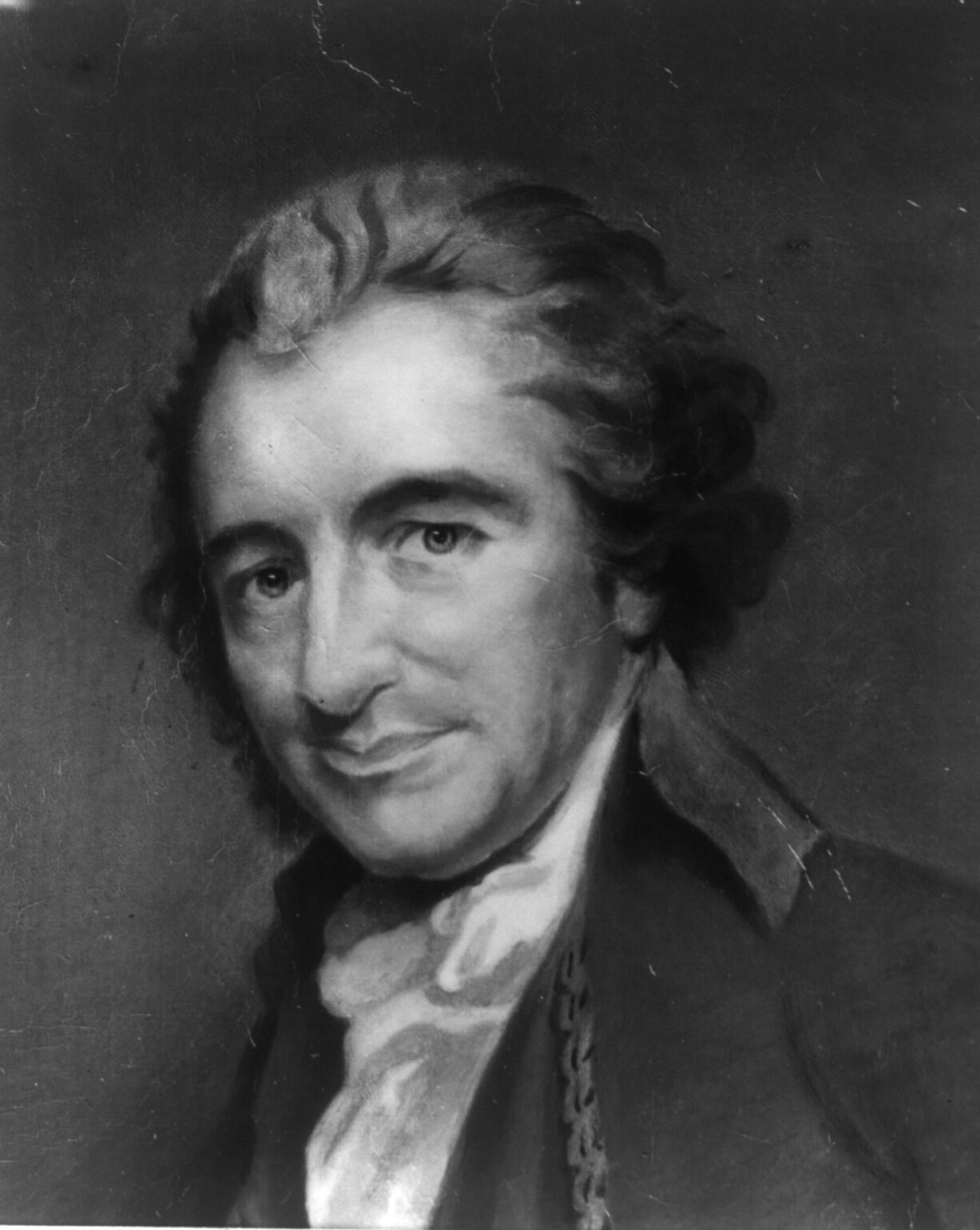
Featured image: Thomas Paine, after a portrait by Auguste Millière, Library of Congress, Wikimedia Commons, public domain.